
Stop viewing your software team as a factory.
A factory is designed for linear throughput—raw materials go in, finished widgets come out. It relies on a critical assumption: the output is known, and the quality is fixed. In a factory, you aren’t figuring out what to build; you are just trying to build it faster.
But in software, we are rarely paving a road; we are exploring a maze. We often don’t know the right solution until we’ve built the wrong one. This requires not a factory line, but a nervous system—an organism that senses, learns, and adapts to its environment.
In a nervous system, coordination is survival. The hand must know what the eye sees. If the hand moves faster than the eye can track, it doesn’t build; it smashes.
Right now, the software industry is making a dangerous mistake. We are using AI to inject our organisations with massive amounts of muscle (coding speed) without upgrading our senses (observability) or our immune system (security).
The Illusion of the “Super-Coder”
The mistake begins with the “Super-Coder” fallacy.
When AI coding tools arrived, the immediate instinct was to reinvest the time saved back into more coding. If it used to take four hours to write an endpoint, and now it takes fifteen minutes, management expects 16x more features.
This fails because of a fundamental law of constraints: Typing is not the bottleneck.
Senior engineers have known this for decades. We spend the vast majority of our time reading, designing, and debugging. Optimising the typing speed is like buying a Ferrari to sit in a traffic jam; it feels powerful, but you arrive at the same time.
In this case, the traffic isn’t on the road; it’s at the toll booths.
- Pull Requests sit stagnant because humans can’t review code as fast as AI generates it.
- CI/CD pipelines clog under the weight of constant commits.
- QA teams drown in regression testing for features that weren’t fully thought out.
- Specialist Teams (Security, SRE, Data) are besieged by a relentless stream of designs and changes they cannot vet.
Worse, code is not an asset; it is inventory. It is a liability you must house, secure, and maintain. When you use AI to produce more code that you understand less, you are not generating value. You are stockpiling debt at record speeds.
Systemic Shock: The Autoimmune Response
This creates a biological crisis: Systemic Shock.
We are effectively injecting our engineering organism with a massive influx of foreign material (new code) without scaling the immune system to match.
The downstream systems—Security, SRE, and Data—are overwhelmed. In biology, when the volume of foreign material exceeds the body’s ability to identify self from non-self, the result is inflammation. The system treats the new code not as a feature, but as a pathogen.
This is where “Shift Left” devolves into “Dump Left.”
The industry logic of Shift Left was sound: move concerns earlier in the process to catch errors cheaply. But without support, we simply dumped the cognitive load of five specialists onto one generalist. We took away their co-pilot and then yelled ‘fly faster!’
The organism reacts by either missing threats (letting vulnerabilities slip through) or going into hyperdrive (blocking every deployment). The developer has the capacity to deploy quickly but lacks the coordination capability to ensure alignment with the database, security, and reliability standards.
The Structural Fix: Neural Coordination
How do we survive this? We must reinvest the “AI dividend” not into speed, but into competence and coordination.
The goal is to evolve the “AI-Augmented Generalist.”
Previously, it was unreasonable to expect a single person to serve as a security researcher, a database administrator, and a UI designer. The cognitive load was simply too high. This necessitated a system of “Bureaucratic Coordination”—teams of specialists exchanging work through tickets and meetings. This is slow, expensive, and lossy.
AI changes the equation. It shallows the curve to competence for these specialist domains.
By using AI to handle the execution of second-level tasks (Security, Reliability, Data Integrity), the Generalist can internalise the feedback loop. We replace Bureaucratic Coordination with Neural Coordination.
The “Shared Brain” Effect
When a developer uses AI to audit their code for security vulnerabilities as they write it, they are effectively sharing a brain with a Security Analyst.
- Zero Latency: They don’t wait three days for a security review; they make the decision instantly.
- Contextual Integrity: They don’t hand off the context; they maintain the big picture.
The AI-Augmented Generalist doesn’t replace the expert specialists. Instead, they shift 80% of the menial, repetitive “immune system” work leftwards, handling it themselves with AI guardrails. This frees the true experts to focus on novel threats, complex architecture and supporting tooling, while the Generalist handles the day-to-day integrity of the system.
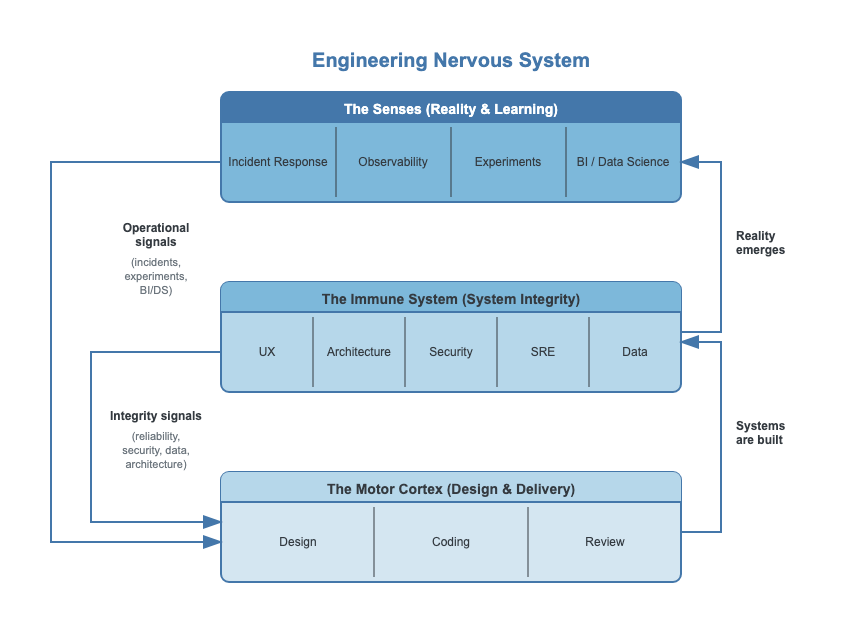
How this looks in practice:
- Design and Delivery (The Motor Cortex): The brain visualises the movement (feature) before sending signals. The muscle contracts (code created).
- System Integrity (The Immune System): The immune system protects the body from pathogens (security exploits and vulnerabilities), environmental changes (load, error rates) and adapts to new needs (architecture and data). Just as when you touch a hot stove, your hand pulls back before your brain processes the thought “that is hot”, automated rollbacks, circuit breakers, and dynamic data masking provide these automatic protections.
- Reality and Learning (The Senses): We can also hold our hand over the stove before touching it. Our senses allow us to understand the world around us, feeding our next planned movement. Sensory exploration allows us to feel, hear and see (experiments and observability). Sensory perception transforms raw sensory inputs into images and sounds, which are processed and used to inform subsequent movement.
The Asymmetric Advantage of Embedded Quality
Why does this matter? Because we live in a world of radical asymmetries.
AI has commoditised the “functional” part of software. Anyone can generate a generic app that “works.” The competitive advantage now lies in the Senses and Reflexes. It is not just having a Security Team; it is having a Security Reflex. By the time a specialist team finds a vulnerability, the code is already cold. An AI-Augmented Generalist, however, operates like a reflex arc—sensing the ‘heat’ of a bad design and pulling back instantly, before the burn happens.
In the modern era, outcomes are increasingly non-linear. A single privacy breach or security failure can kill a brand overnight. Loved products, advocated by the right influencer, can turn a product into a rocket ship.
We now see things that usually get cut when we rush, as our senses that are critical to our competitive advantage – reflex speed:
- Privacy is no longer a compliance checkbox; it is a brand asset.
- Accessibility is not a “nice-to-have”; it is a market expander.
- Performance is a growth engine.
The AI-Augmented Generalist finally has the bandwidth to address these issues. By offloading the rote coding to AI, we can stop building feature factories and start building robust, living organisms.
Conclusion
We must stop measuring engineering success by the volume of code produced. That is a metric for a factory, and we are building something far more complex.
We are building a nervous system. The goal is not to twitch the muscle as fast as possible. The goal is to ensure the hand knows what the eye sees, the body reacts to pain before it burns, and the immune system recognises a threat before it kills the host.
Don’t use AI to type faster. Use it to coordinate better.
 Lee Campbell